How Do You Convert .fbc Files So Can Be Read by Family Tree Maker
Equally you lot find your family history, it'due south of import to tape where y'all find each piece of data. Let's say you lot've constitute conflicting records with your grandfather's engagement and place of birth. The engagement he celebrated his altogether doesn't match what'due south in the family Bible, and the place where he said he was built-in doesn't match what his nativity certificate says. If you keep track of all those sources, you'll exist able to detect and compare them and maybe even determine which one is the most reliable. Later on, if yous share your family unit history in writing, you'll be able to include footnotes that provide testify for your claims, and requite credit to those whose works you consulted. Relatives will know they can depend on your research and build on what yous've done without having to repeat it. Most of all, you'll be confident that you've gotten equally close as you lot tin to the truth about your family history.
Source citations have an intimidating reputation as difficult to write and incommunicable to organize. Fortunately, genealogy software helps you exercise both. Most programs permit you describe the birth certificates, demography records, personal interviews and other sources you have for births, marriages, deaths and other facts. You tin can link these descriptions to their corresponding facts and create reports with correctly formatted footnotes or endnotes. You also can include your source citations when you submit your family file to an online family unit tree database. If you share your file with relatives who utilize genealogy software, they won't need to re-enter all your sources.
We'll show yous how the electric current versions of three popular desktop genealogy programs—Family Tree Maker, Legacy Family Tree and RootsMagic—can plough the sometimes-scary task of source citation into a satisfying ane instead.
Source Commendation Basics
Genealogists utilize a lot of specialized sources, such as family Bibles, microfilmed church records and online demography records. What a source citation looks similar varies with the type of record, but in full general, a source citation has 4 parts: author, title, publisher (including identify and year) and locator (usually a page number or certificate number). If the source is online, such as an Ancestry.com collection or a Google book, you should cite the original work (frequently a book, microfilm or manuscript), equally well as the website's title and URL, and the appointment you institute the information you're citing.
Database descriptions on Beginnings.com, FamilySearch.org and other genealogy websites usually state the source of the data, but these bibliographic references are often not written in a consistent format—or one that follows accepted genealogical commendation standards. Those standards are set forth in two books by Elizabeth Shown Mills, both from Genealogical Publishing Co.: Evidence! Citation & Analysis for the Family Historian and Evidence Explained: Citing History Sources from Artifacts to Cyberspace, 2nd edition.
Family Tree Maker, Legacy Family unit Tree and RootsMagic all use Evidence Explained equally a guide for creating source citations. Genealogy software lets you attach a source citation to just about every "fact"—a name, identify or life event—in your tree. Nigh of your source citations will be linked to events, such every bit births, marriages and deaths, merely every bit yous'll see, some might exist linked to a person or a family. You besides tin quote from the source, annotate on information technology, attach a scanned re-create of it and rate its reliability.
In most programs, you'll create citations in ii steps. Beginning you add a source. Templates let y'all create dissimilar types of sources, so it's mostly a matter of filling in the blanks. Select a template for the appropriate source type and fill up in each field for author, title, publisher, repository (where you constitute the source), etc. In one case you create a source, you can save it and use information technology to cite other data you've constitute in that source. Then you might have one "master source" (such every bit the Cincinnati Birth and Decease Records, 1865-1912 database) with multiple citations from that source (if you lot've establish birth and death records for many relatives in the aforementioned database).
As you enter source citation information, your genealogy software automatically formats information technology to create 3 types of references used in written family histories and reports:
- Bibliographic entry: As well chosen a source list entry, this is information about the source itself, such every bit a book or online database. You'd include it in a bibliography of sources accompanying your family history book or report.
- Footnote/endnote: This full reference note includes data about the source, plus a locator for the specific data you found in it (such equally birthdate or occupation). It serves as a numbered footnote or endnote in your family history or report.
- Brusk footnote or subsequent commendation: If you lot refer to the same source multiple times in a report, you don't have to use a full footnote or endnote citation each time. Instead, for the second and later references, apply this short form of the full reference note. Information technology includes a locator for the specific information institute, plus abbreviated source information.
Family unit Tree Maker 2019
With MacKiev's best-selling Family Tree Maker software, yous can create a source citation starting from either Tree view or Person view in Family unit Tree Maker 2019.
In Tree view, look in the right console, where you see facts most the person whose contour is highlighted. Each fact with a source citation has a source icon (it looks like a quill pen writing on paper) to its right; click to add a new source. Facts without source citations take no icon. Mouse over the fact and a source citation icon with a plus sign appears. Click on information technology to add together a citation for that fact.
From Person view, click on a fact almost the person in the eye panel, and you'll come across all the sources for that fact in the detail panel on the right. To add together a new citation or use an existing source with a different citation, click on New and cull Add together New Source Citation.
How to Create a Source Citation Using Family Tree Maker 2019
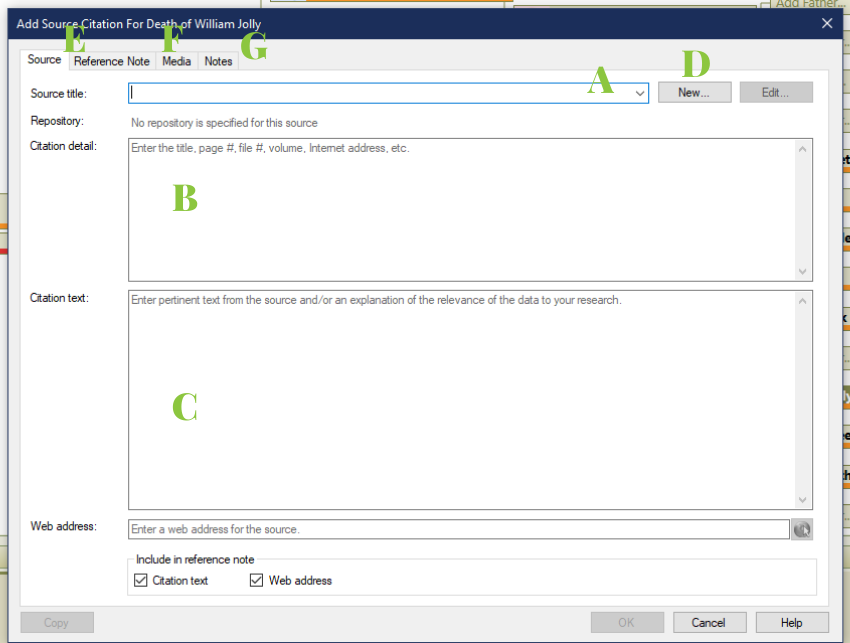
In the Add Source Citation window, use the down arrow in the Source title field [A] to choose a source you've already cited (or brainstorm typing the championship of the source you're looking for in the field). Or, to edit the source, click the Change push. Then add new source details. In the Citation Detail field [B], yous could add the page number of a book or a demography enumeration commune and folio number. In the Citation Text field [C], add transcribed information from the book or census record.
If you haven't already used the source you want to cite, you can click the New button [D] in the Add Source Citation window. This brings up the Add together Source window, where yous tin search for a template for the kind of source you're citing by entering a word such as birth or death in the Source template field. To browse source templates arranged in categories, click the More than button. Begin by selecting i of a dozen broad source groups, such as Census Records, before working your way down through Categories and specific source types. For example, to document an online census image, select the Demography Records source group, which leads to several categories: Original Manuscripts, Digital Images, Microfilm and Derivatives. Select Digital Images so a template; for an online census collection, you might choose Online Commercial Site—Generic (by Census Year).
Family Tree Maker has fewer source templates than Legacy and RootsMagic. For instance, I can't discover templates for passenger lists or Canadian demography records. If y'all can't detect a template for a detail source type, use a generic template, such as Database Online—Generic (whatsoever country; any online database). Alternatively, you lot can leave the template field blank and use the generic default template.
Clicking OK in the Add Source window opens the Add Source Commendation window, where y'all tin enter details for this citation, including a description, text from the citation (such as a grave marking inscription) and a web address (if applicable). Popup instructions prompt y'all on the type of information to add. The window has three other tabs: Reference Note [E] shows how the citation will appear every bit an endnote in a report. Click inside the text box and you lot can select text to italicize or underline. Select the Media tab [F] to adhere an image of the source, such as a digitized rider list page. Employ the Notes tab [G] to add together comments to the source citation.
Family Tree Maker's Sources workspace, which you lot tin admission by clicking the Sources link in the navigation bar at the top of the screen, lets you manage your sources and run across how they're used in your tree. For example, click on a source under Source Groups on the left, and a listing of citations based on that source will appear in the center of the screen. If you click on 1 of those citations, the panel below will bear witness you each person and fact that source citation is linked to. On the right, you'll run across commendation particular and text, also equally the reference notation, for the highlighted source commendation, and you tin can click to edit the commendation or source. The Edit Source window lets y'all add a Source Repository, such as a library where yous consulted a printed urban center directory or a website where you found a demography database.
Quick Tips
Family unit Tree Maker has means to speed up citing the same source multiple times, such as when you find several members of a family in the aforementioned household in a demography. To cite a source for the start person, highlight the census fact, expect under the Sources tab and, in the right panel, select New > Add New Source Citation. When you're washed, go to the next person in the household, create a census fact, highlight information technology and on the right, select New > Use Existing Source Citation. That opens up the Find Source Commendation window with the concluding commendation you used highlighted.
Select Link to Citation to use the same page number or pick Create New Re-create to cite a different page number.
Here's another fashion to apace link a source citation to facts for a series of people: Click on the Sources tab and select a citation. Under the Links tab, click on New. And then select a fact for another person and click OK.
You as well tin can copy and paste a source citation. Select a fact in Facts or Timeline view, and then select a source linked to information technology. Click on the Re-create Source Commendation icon (it looks similar two duplicate pages). Then highlight another fact associated with the same person or someone else. Nether the Sources tab, click the down arrow abreast New. Select Paste Link to Source Citation to use the aforementioned page number or Indistinguishable Source Citation to enter a different page number.
Yous can search Beginnings.com for someone in your Family Tree Maker file and incorporate matching records into your tree. Family unit Tree Maker links the source information to each fact, only the source citations often lack primal information or aren't formatted properly. For example, if y'all merge information from a Public Fellow member Tree, the source commendation references Beginnings.com, as it should, but not the tree'south possessor. And then it's usually worthwhile to create your ain source citation, rather than using the one Beginnings.com generates automatically.
Legacy Family unit Tree nine.0
Legacy software guides you through a simple footstep-by-step process to create source citations using an extensive fix of more than than ane,200 source templates for the United States and other countries. A SourceWriter guides you through the whole process.
How to Create a Source Citation Using Legacy Software
Start by double-clicking on a name in Family or Pedigree view to open the Individual's Information window. To link a source citation to an outcome, click on the source citation column (the 1 headed by a books icon) in the row for that event. (A books icon in that square indicates that at to the lowest degree one source commendation is already attached to the event.) This opens the person's Assigned Sources window, which shows all the sources assigned to the person and the person's events. The event you lot selected is highlighted. To cite an existing source, click Cite a Master Source. To cite a new source, click Add a New Source, which opens the SourceWriter.
When creating a new Master Source, the SourceWriter starts by asking you a serial of questions so it can select the best source template. Yous can either enter a general source type, such every bit census, to find matching templates, or choose a general source blazon from the list. If you select Census Records, you're prompted for a country. Select the United states and y'all're asked to select the blazon of demography tape. Cull Federal Census Records and then you can select a yr betwixt 1790 and 1940. Finally, you'll select a medium—microfilm/fiche or online images. Then click Go to Stride 2.
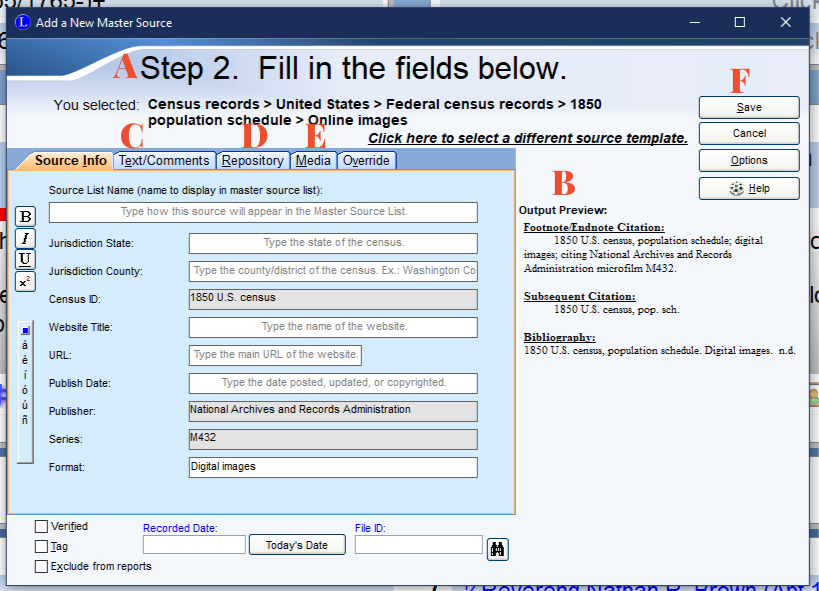
Step 2 opens the template for the source type y'all selected [A]. Some fields may already be populated. For example, for online images of the 1920 demography, the template is already filled in with "1920 US census," the publisher (National Archives and Records Administration), the microfilm series (T625) and the format (Digital images). Just fill in the remaining blanks with the data specified, such as the state, canton, website name and URL. On the correct, yous can see a preview of the footnote or endnote citation, the subsequent commendation and the bibliographic reference [B].
Step 2 likewise has tabs where y'all can add together a quotation from the source and comments on it [C], the repository where yous found it [D] and digital files [E]. These are meant to apply to the Master Source, not to the specific data you're citing. When you're finished, click the Save button [F].
In Step 3, y'all'll add source details. Merely fill in the blanks for each field, such as city and page number. The File ID field is optional; yous can employ it to reference a document number you might write on paper files. Use the tabs here to add a quotation, comments or uploaded media (such every bit an image of a census folio) that pertain to this specific commendation.
Quick Tips
Once y'all've created an event and attached a source citation to it, yous can easily copy and paste the event and citation at the same time, a existent timesaver. Let'southward say you lot found a family unit in a demography record and you want to add the same demography consequence and source citation to each person in the family. Create a census fact for one person and attach a source citation to it. In the Individual's Information window, click on the census event to select it and striking the Edit push button. In the Edit Event window, click on the two-page icon on the right to copy both the event and the citation to the Clipboard. Now open up the Individual'south Information window for another fellow member of the family who appears in the same census record. In the Events/Facts section, click on the Add button and then click on the push button in the lower correct corner to paste the issue and citation from the clipboard. Hit the Save push and move on to the next person in the family.
You can shop citations in up to 10 Source Clipboards for handy access. Each Clipboard tin hold upwards to five citations, all of which can be pasted at once. You could put sources you employ frequently (such every bit demography records) or that you're working on currently, in clipboards. Or organize sources in clipboards by family or source type.
If you have a source that provides general information on a person, you can create an individual or person source. For case, if an obituary or a biography in a county history provides details pertaining to a person's birth, marriage and death, yous could link the citation to the person, rather than separately to the person'due south nascency, spousal relationship and expiry events. (Family Tree Maker doesn't support individual sources. When importing individual sources from another program, Family unit Tree Maker converts them to name sources.)
RootsMagic 7
RootsMagic makes it easy to create source citations using a huge collection of source templates for the United states and other countries. The plan's Citation Manager helps you lot add, edit, copy and delete source citations. To admission it, open a person's Edit Person window, highlight a name or a fact, then click on either the Sources button in the edit pane on the correct (it looks like a document) or the Sources column (headed by a picture of a certificate) in the same row as the name or a fact y'all're working with.
Here'south another way: Highlight a name in any navigation view and click the Edit Sources icon (it also looks like a certificate) in the toolbar at the top of the screen. So select Person for general individual sources, Family unit for family unit sources or Source List to see a list of all primary sources.
How to Create a Source Commendation Using RootsMagic
Start, click the Add New Source push button in the Citation Manager. That opens the Select Source Blazon window where you can browse the list of types. When you highlight a source type, the right window shows a description of information technology and the page number where it'southward discussed in Evidence Explained. Utilise the three buttons at the peak of the window to speed upwards the process: Highlight a source type yous use frequently and click on the star push button to arrive a favorite. Employ the Favorites push to access favorite source types or the Contempo button to select a recently used source type.
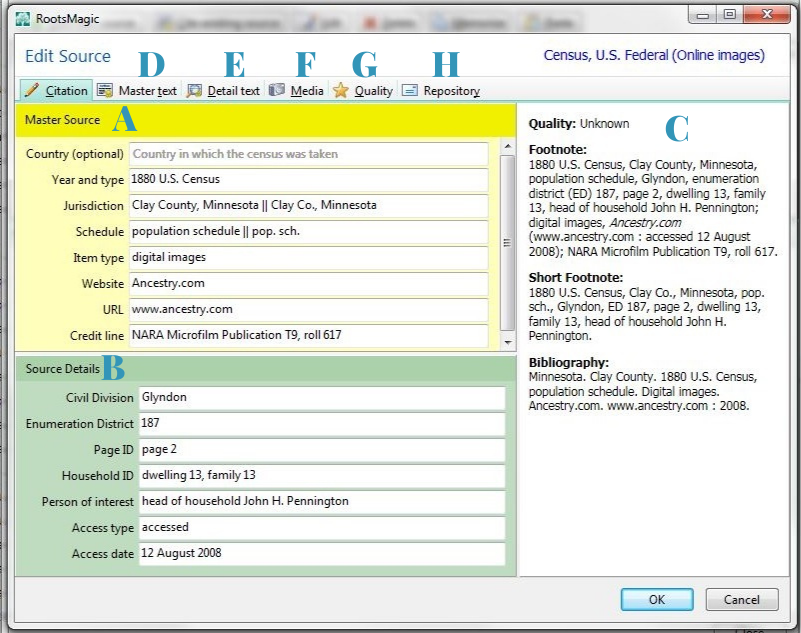
When y'all select a source type, the Edit Source window opens up with several tabs. The Citation tab has three sections: The xanthous department at the top has fields for entering Master Source information [A], the green section at the lesser has the Source Details fields [B], and the right section displays a preview of the reference as a footnote, a brusque (or subsequent) footnote and a bibliographic entry [C]. Just fill in the blanks to create or edit the source. It'southward convenient to be able to view the Master Source while you lot add together source details.
The Edit Source window has several other tabs: Chief Text [D] holds a quote and comments that utilize to the source in general. Anything you put here appears with all citations to this source. The Item Text tab [Eastward] holds text and comments that pertain to this specific commendation. The Media tab [F] lets you attach digital files (document images, photos or sound or video) to the source and commendation. Quality [G] lets you charge per unit the source's reliability, and Repository [H] lets you tape where y'all establish the source, such as an archive or website.
Quick Tips
One time you create a source commendation, you tin quickly copy and paste it to another person, family unit or fact. For instance, when you find family members listed together on a census record, create a census fact linked to a source citation for one member of the family. Highlight the source citation in the Citation Manager and click the Memorize button
Then add the same census fact to each of the other members of the family who announced on the aforementioned census record. Ane by 1, highlight each new fact, click the Sources push button and hit the Paste button to copy the source citation.
If you lot accept a source that applies to a whole family unit, such equally a census household list, you can create a family source in RootsMagic. In the Edit Person window, highlight a spouse and click in the sources cavalcade. When importing family sources from another program, Family Tree Maker and Legacy Family unit Tree convert them to marriage sources.
Like Legacy Family Tree, RootsMagic lets you create an individual or person source: In the Edit Person window, highlight the person'due south name and click in the sources column. As noted, Family Tree Maker converts private sources to name sources when importing files from other programs. RootsMagic doesn't support proper name sources and converts them to individual sources when importing.
From the May/June 2015 Family Tree Magazine

Deciding where you want to store your family tree, whether online or via software, can be a tough choice. Here, we'll provide you with the tools to make up one's mind which online tree or family history software is best for yous!

Looking for the perfect tool to help y'all record, organize and share your genealogy? Our guide to genealogy software explains how to find the right program for y'all.
FamilyTreeMagazine.com is a participant in affiliate programs through Amazon and Genealogical Publishing Co. It provides a ways for this site to earn advertising fees, by advertising and linking to affiliated websites.
Get Your Free Essential Genealogy Research Forms
Sign upward for the Family Tree Newsletter and receive ten inquiry forms as a special thanks!
Get Your Costless Genealogy Forms
carltonwhoine1999.blogspot.com
Source: https://www.familytreemagazine.com/research/genealogy-software-source-citations/
0 Response to "How Do You Convert .fbc Files So Can Be Read by Family Tree Maker"
แสดงความคิดเห็น