Winchester 38 Special Train and Defend Ammo Review

When information technology comes to designing ammo, many of the objectives conflict with each other – you lot can't take them all. For example, perfect ammunition would have all of the following:
- Low recoil
- Low blast and muzzle wink
- Low noise
- Reliable expansion, even later on passing through tough barriers like 10 copies of the New York Times Sunday edition
- Deep penetration
- No over penetration
- High velocity
- Weight retention
- Machine replenishment. Ok, no one has figured that out yet, but I did say "perfect" ammunition, right?
Given that you tin't have combinations like Mach 7 velocity, 4x expansion after passing through Atomic number 26 Man and no measurable recoil, ammunition manufacturers make up one's mind in advance what performance they want and for what purpose the ammunition will be used.
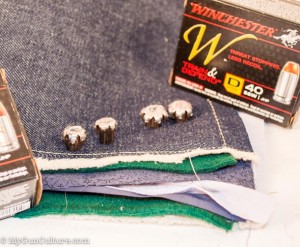
Both 9mm and .40 South&W Defend loads were tested with bare gelatin and multi-layer fabric.
Winchester Armament launched its new Train and Defend line with some pretty clear goals. Co-ordinate to the company, Railroad train and Defend is aimed (come across what I did there?) at "new shooters interested in training to become more than practiced with their personal defense force ammunition."
What does that hateful?
First, in that location are two varieties of the ammo: Train, and, you guessed it, Defend. Both are loaded to yield the same basic functioning and feel. If you fire a round of Train ammo, followed by a round of Defend, y'all won't exist able to tell the difference. This is kind of a big bargain.
Winchester Train ammo
Normally, practice ammo is lower powered and, therefore, much more mellow to shoot. When you load a round of full powered self-defense force ammo, you'll feel it. The boom and recoil volition be substantial in most cases. Not so with Railroad train and Defend – both rounds feel the aforementioned and perform similarly. The Train version is loaded with full metal jacket bullets which result in a much lower toll per round – appropriate for exercise. On the street, expect to pay less than half the price of a Defend round for each Train circular. It's like shooting fish in a barrel to place every bit it has a big "T" logo on the box.
Winchester Defend ammo
When you're finished practicing, load your magazines up with Defend. This is what y'all want for personal protection and abode defense applications. The Defend ammo uses bonded projectiles that ensure the bullet stays intact and retain its original weight. The cases are nickel-plated for corrosion resistance and improved feeding. You'll spot the Defend version past the big "D" logo on the box.

I tested the 9mm Defend load with a Beretta 92FS. Using the SilencerCo Octane suppressor was added fun as this load is subsonic.
I got all geeky about how the Train and Defend ammunition is put together and posed some questions to the production manager. Are the Train and Defend Loads identical except for the projectile? Practice they use the same powder?
Here are the answers from Winchester:
"The Train and Defend loads practise not use the same pulverisation and there is a good reason for that. We utilize depression-flash powders in our Defend options, considering a defensive situation is probable to occur in low-light atmospheric condition; it is important that night vision non be impacted due to a bright muzzle flash. HOWEVER, these low flash powders take a tendency to be slightly dirtier burning, so they are not great options for our Train circular. Nosotros developed Train to exist a nifty loftier-volume training round so we utilize some of our cleaner burning propellants in these loads. Train would be great for competition, depression recoil, 180 grain in twoscore Southward&W will brand for a great competition load."
Performance
Velocity
Every bit part of the pattern goal of Winchester Train and Defend ammunition is to offer lower and more controllable recoil, they're manufactured to travel at lower velocity. I measured both 9mm and .forty Southward&W versions using a Shooting Chrony Beta Master Chronograph placed 15 feet downward range.
forty S&W Train, fired from a Glock 22: 885.three fps
xl S&Due west Defend, fired from a Glock 22: 907.vii fps
9mm Defend:, fired from a Beretta 92FS: 936.3 fps
Expansion
I shot both 9mm and .forty Southward&Due west loads into Clear Ballistics 6x6x16 inch gelatin blocks. Co-ordinate to the manufacturer, the blocks are calibrated to 10% ballistic gelatin standards as used past the FBI for ammunition testing.
Assuming that penetration of these lower velocity rounds would be less than xvi inches, I just brought one block to the range. You know what they say about assuming right? Exactly. All of the 9mm and .40 Due south&West rounds tested exited the block and were stopped past my expired Kevlar vest backstop, and then the but penetration measurement I tin can offer is "more than than 16 inches." That'due south enough.
For both 9mm and .forty S&W Defend loads, I fired ii scenarios. For the first, I used bare gelatin. For the 2d, I covered the front of the gel block with the new standard light denim, multi-layer fabric designed to simulate average street clothing layers.
The 9mm projectile surprised me somewhat. Projectiles fired into blank gel and those shot through the test fabric all expanded properly. The blank gelatin bullet expanded to a smaller bore than the one fired through cloth layers. That might have been caused by gel anomalies or perhaps the lower overall resistance allowed the bullet to travel at college velocity, thereby pushing back the petals further. I measured expansion of this projectile at 0.535 inches. The projectile fired through the fabric layers expanded to 0.605 inches diameter.

The Defend .forty Southward&West rounds expanded beautifully in bare gel and afterwards passing through fabric barriers.
The .40 Due south&W Winchester Defend projectiles also expanded properly in both examination scenarios. The bare gelatin projectile expanded to 0.690 inches while the projectile fired through material layers expanded to 0.685 inches diameter.
In summary, I found this ammo comfortable to shoot and functioning matched its design goals. Expansion worked properly afterwards passing through "normal" clothing layers. Winchester Train and Defend ammunition is a smashing option for newer shooters where the reduced recoil will help keep shots on target and allow for faster and more accurate follow-up shots.
Share This Article

carltonwhoine1999.blogspot.com
Source: https://mygunculture.com/ammo-review-winchester-ammunition-train-and-defend/
0 Response to "Winchester 38 Special Train and Defend Ammo Review"
แสดงความคิดเห็น